
Testosterone Carrier Oils Explained: MCT vs Seed Oils
Most men focus on the testosterone dose, injection frequency, or whether they should inject subcutaneously or intramuscularly. But another part of the conversation can have a real effect on the treatment experience: the carrier oil.
Injectable testosterone esters such as testosterone cypionate and testosterone enanthate are dissolved in oil-based vehicles. Those oils can affect viscosity, injection feel, local tolerability, and the practical behavior of the medication once injected. What many patients want to know is simple. Does the oil matter, and is one better than another?
The short answer is yes - the oil can matter, especially for comfort and tolerability. What is much less clear is whether one carrier oil consistently produces better testosterone blood levels than another. In particular, MCT oil is widely discussed in compounding practice, but strong peer-reviewed human studies directly comparing MCT-based testosterone with seed-oil-based testosterone for serum testosterone levels are very limited.
What is a testosterone carrier oil?
A carrier oil is the oil vehicle used to dissolve and suspend testosterone ester for injection. Different testosterone products use different oils. For example, the DailyMed label for testosterone cypionate lists cottonseed oil in the formulation, while the testosterone enanthate label lists sesame oil. These are common examples of seed oils used in testosterone products.
In practical terms, the carrier oil can influence:
how thick the solution feels
how easily it draws into and pushes through the syringe
how the injection feels in the tissue
whether a patient develops irritation or local reactions
and possibly how the depot behaves after injection, although the direct TRT evidence here is limited
Why carrier oils matter
From a clinical standpoint, carrier oils matter most for three reasons.
1. Viscosity
Some oils are thicker than others. In general, higher-viscosity oils are harder to draw and inject, especially through smaller needles. Broader pharmaceutical literature on long-acting lipophilic injections supports that oil viscosity influences injectability and depot behavior.
2. Injection comfort and local tolerability
A patient may tolerate one oil well and another poorly. Reactions can include redness, swelling, itching, warmth, or prolonged soreness at the injection site. That does not always mean the person is reacting to testosterone itself. Sometimes the oil or another excipient is part of the problem.
3. Allergy or sensitivity history
This matters most with sesame oil, since sesame is a recognized allergen and allergic reactions to sesame oil are well documented.
Seed oils in testosterone formulations
Many testosterone products use seed oils, especially cottonseed oil and sesame oil. MCT oil is more commonly discussed in compounding practice and is often chosen because some patients feel it is easier to inject or tolerate.
A practical way to compare them is this:
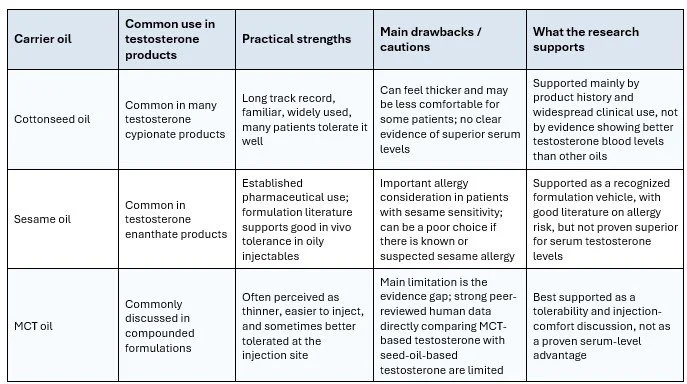
The examples above are grounded in labeling for testosterone cypionate and enanthate products, along with formulation-science literature on oil-based injectables and allergy literature for sesame oil.
Bottom line on the oils
In day-to-day practice, the choice of carrier oil is usually less about chasing better testosterone numbers and more about finding a formulation the patient can inject comfortably, tolerate consistently, and stay on long term.
If a patient is doing well on a current formulation, there may be no reason to change. If injections are uncomfortable, hard to push through the needle, or causing repeated local reactions, then the carrier oil becomes much more relevant.
Does viscosity affect serum levels?
Possibly, but the answer is more nuanced than many marketing claims suggest.
General long-acting injectable literature supports that drug lipophilicity, vehicle viscosity, and depot characteristics can influence how an injected drug is released over time. More viscous oil solutions may clear more slowly from tissue.
That said, there is a big difference between what is theoretically true in formulation science and what has been clearly shown in men on testosterone replacement therapy.
For TRT specifically, there is not strong direct human evidence showing that MCT oil or common seed oils produce major, predictable differences in testosterone serum levels when dose, ester, route, and frequency are otherwise comparable.
So what should guide the choice of oil?
For most men, the best reason to choose one carrier oil over another is not because it is proven to produce better lab numbers. It is because it may be a better practical fit.
The most useful questions are:
· Is the injection comfortable enough to stay consistent with?
· Is the solution too thick for the preferred needle size?
· Is there a history of local swelling, heat, redness, or itching?
· Is there a known sesame allergy or another likely sensitivity?
· Is the patient doing well enough on the current formulation that there is no reason to change?
In other words, the carrier oil discussion is usually more about comfort, consistency, and tolerability than about chasing a theoretical serum-level advantage.
What this means for men on TRT
If you are doing well on your current testosterone formulation, there may be no reason to obsess over the oil. If you are having repeated injection-site problems, difficult injections, or suspected sensitivity, then the carrier oil absolutely becomes part of the conversation.
The key is not to assume that a “better” oil automatically means better testosterone results. In many cases, the bigger wins come from the right dose, frequency, route, and monitoring plan, with the oil selected to improve comfort and long-term consistency.
Conclusion
Testosterone carrier oils are not just an afterthought. They can affect viscosity, injection feel, local reactions, and allergy risk. MCT oil and seed oils each have a reasonable place in the conversation, but for different reasons. At this point, the strongest reason to choose one oil over another is usually tolerability, injection comfort, and allergy profile - not because one has clearly proven superior testosterone blood levels over another.
If you are having injection-site issues or want to understand whether a different testosterone formulation may fit you better, that is a worthwhile conversation to have with your clinician.
Enhanced Metabolics provides men’s health telemedicine for patients in Arizona and Florida, with a focus on hormone optimization, performance, and long-term health. Book a consult to review your TRT plan and discuss whether your current testosterone formulation is the right fit.
Enhanced Metabolics provides clinician-guided testosterone therapy telemedicine for men in Arizona and Florida. If your injections have been uncomfortable, hard to tolerate, or difficult to stay consistent with, book a consult to review your TRT plan and whether a different formulation may be a better fit.
FAQs
What is the best carrier oil for testosterone injections?
There is no single best carrier oil for every patient. The best choice usually depends on tolerance, allergy history, injection comfort, and product availability.
Is MCT oil better for testosterone injections?
MCT oil may be easier for some patients to tolerate, but strong peer-reviewed evidence showing better testosterone serum levels with MCT oil is limited.
Are seed oils a problem in testosterone injections?
Not usually. Many standard testosterone formulations use seed oils such as cottonseed or sesame oil. The main exception is in patients with a known or suspected sesame allergy or in patients who experience repeated local reactions.
Does carrier oil change testosterone blood levels?
It may influence depot behavior in theory, but strong TRT-specific human evidence proving major differences in serum testosterone levels by carrier oil is limited.
References
1. Larsen SW, Larsen C. Critical factors influencing the in vivo performance of long-acting lipophilic solutions: impact on in vitro release method design. AAPS J. 2009. Available at: https://pmc.ncbi.nlm.nih.gov/articles/PMC2782087/
2. Wilkinson J, Ajulo D, Tamburrini V, et al. Lipid based intramuscular long-acting injectables: current state of the art. Eur J Pharm Sci. 2022. Available at: https://www.sciencedirect.com/science/article/pii/S0928098722001385
3. Pharmacokinetic comparison of testosterone replacement delivery systems. Available at: https://pmc.ncbi.nlm.nih.gov/articles/PMC10037700/
4. Kanny G, De Hauteclocque C, Moneret-Vautrin DA. Sesame seed and sesame seed oil contain masked allergens of growing importance. Allergy. 1996. Available at: https://pubmed.ncbi.nlm.nih.gov/9020427/
5. Testosterone Cypionate Injection, USP. DailyMed. Available at: https://dailymed.nlm.nih.gov/dailymed/fda/fdaDrugXsl.cfm?setid=f60c5520-b336-44a2-95d5-f274939fa595
6. Delatestryl (Testosterone Enanthate Injection, USP) label. Available at: https://www.accessdata.fda.gov/drugsatfda_docs/label/2014/009165s032lbl.pdf
Educational disclaimer
This blog is for educational and informational purposes only and should not be considered medical advice, diagnosis, or treatment. Testosterone therapy and compounded formulations should only be used under the guidance of a licensed healthcare professional. Individual responses, risks, side effects, and monitoring needs vary from person to person. Do not start, stop, or change prescription medications or supplements based on online information alone.